If you frequent online reading spaces, whether it’s reddit, social media, or anywhere else, you’ve probably been bombarded by talks of TBRs. (in case the term is unfamiliar, it means to-be-read) There are people complaining about how long their TBRs are, showing off their TBR shelves, stacks, and journal entries.
Some are spinning wheels to decide which book from their list to read next, some turning their book spine-in to make their list more visually annoying to get themselves to read. Some scream about adding new books to their never-ending piles. Some separate physical, audio, and e-book lists to make it more digestible.
And to be honest, all of this seems exhausting to me.
Not that I never tried to maintain a TBR, mind. I’m a reader and I spend a decent portion of my time online, so I was influenced, what can I say. I’m pretty sure there’s still a long list in one of my notebooks, with a beautiful calligraphy title I spent a good half-hour on.
But here’s the thing: I’m a mood reader. This means that I never know what’ll strike my fancy next. And when I decide on something, I have to read it immediately, book to-do list be damned. Plus, a TBR feels like a chore, something I have to do, and that saps all the fun out of reading.
So, over time, I just… stopped having one. And found my own way to manage all the books I want to read in a more appealing way.
Now, to be fair to everyone: I’m not saying TBRs are bad, or that you shouldn’t have one, especially if it’s working for you, and even if it isn’t. You’re free to do whatever works for you, no judgement from me and hopefully from anyone else. This is just my own system that I’m sharing in case someone else struggles with TBRs as much as I do and wants a different way. Okay? Okay. Let’s go!
The concept of a “wish list”
Oooh, aaah, how creative! Yes, yes, I know – not very. But, this is what I like to call it, and so we’ll stick with that.
On the surface, “wish list” might not sound very different from a TBR. And yes, in some ways, it isn’t.
It still serves the purpose of collecting all the books you’d like to read in one place, just like a TBR would, but the difference is in the mindset, as well as how I use it. We’ll get to the exact usage below, but I’d like to explain the mindset a bit more.
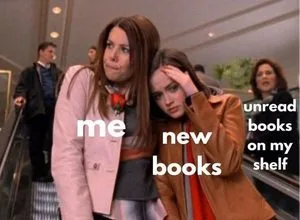
The TBR is a to-do list. Books you have to get to. It stares at you from its spot on your shelf with its beady little eyes and you think about it before you fall asleep, and it stresses you out and you have to finish it before you can buy or try reading any other books.
A wish list is a place for joy. You collect all the interesting titles that grabbed your attention and you might read one, maybe all, maybe none. It’s just a tool to help you remember what you wanted to read and why, maybe a waiting space for a book to go on discount, maybe for all the sequels to come out. It doesn’t stress you out, you don’t have to think about it at all. You can read whatever you want, even if it’s not on the list, no one is judging you.
Of course, no one is saying you can’t use your TBR in a similar way, but the truth is that most people don’t. For the majority, it’s almost like a syllabus (which, nothing against those, but it leaves less room for fun).
So, at the risk of sounding like those LinkedIn bros, or god forbid, a self-help influencer, it’s a mindset switch. You’re no longer giving yourself homework, but instead a lush, thriving garden of choices when you need a soft place to land on.
How to Use the Wish List
It’s important to note that you can stop right here. The beauty of a wish list is that you can use it however you’d like, no rules needed. However, if you’d like to know more about how I use mine to save my money and time, then by all means, the guide below is for you.
Step One: Find a book you want to read
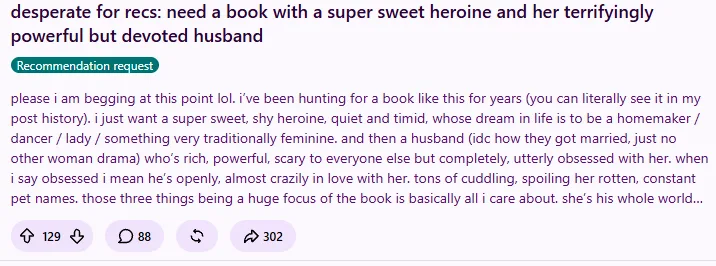
I’m not here to tell you how to do this (at least not in this article), so just, you know, do your thing! Get on social media, reddit, talk to a friend, go on Goodreads, wherever you’d normally go to find your next favorite read (maybe even this blog?).
Have you found the book? Great, perfect! We can move on.
Step 2: Read the free sample
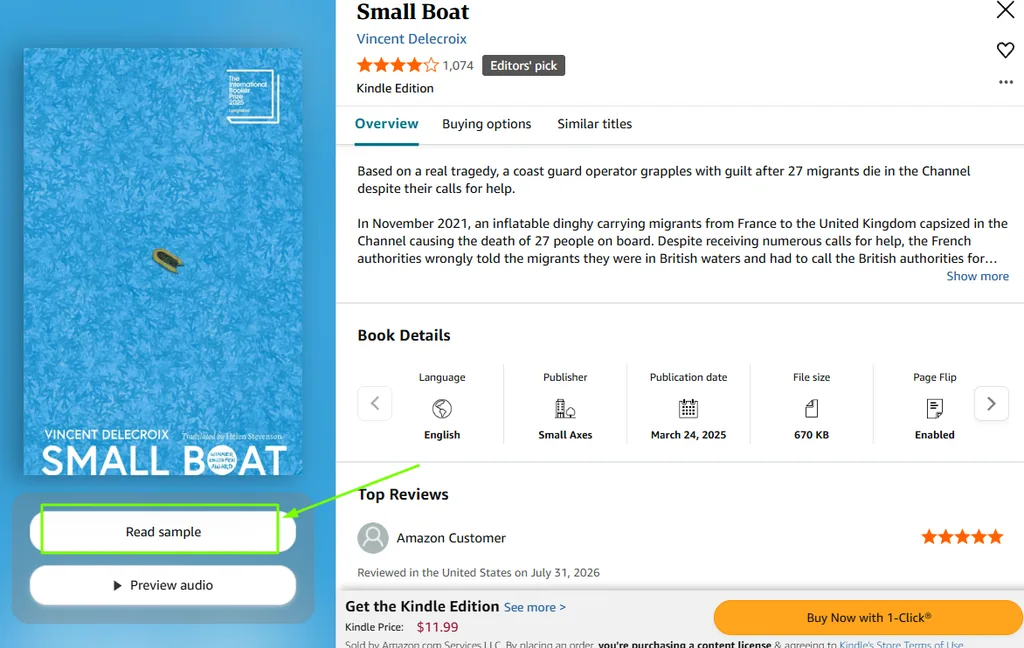
To me, this is the most crucial step of maintaining a wish list I feel joy to come back to. Because look, you may like the concept of a book, or its premise, or even that one quote an author chose to put on that very visually appealing short video. But the reality is, a book might not work for you despite all of that, and for a myriad of reasons.
Maybe the writing style is not for you, maybe the dialogue sounds stilted, maybe it’s in first person and you only read third-person – there’s no way to know unless you try. And try you can, if you just read through the free sample, which almost every book has (around 10 to 20% of its total number of pages).
This little taster is entirely enough to tell you whether you’ll enjoy reading something. At the very least, it’ll help you discard the books you’d hate almost immediately. Which serves three purposes:
- It saves you money. Buying a book without reading a sample first is a mistake I won’t make again.
- It saves you time on reading something you won’t enjoy.
- It keeps your TBR nice and neat, filled with books you actually might love.
This is not to say that I never disliked a book I bought because of a sample. Infamously (well, infamously to me, personally), I liked the sample of The Day of the Duchess, bought the book, and then started hating it at about a half way through. So, it’s not a full-proof method, but at least it’s a first line of defense, and that counts for something. For instance, if I’d read the sample of One for My Enemy by Olivie Blake, I wouldn’t now have a beautiful, illustrated special edition of a book I loathe on my shelf.
Of course, you may not have time to read a sample immediately – that’s fine too.
Sometimes, I get busy and I just write down titles or put them on a digital wish list without reading through. Perfectly okay! Once a week (or periodically, whatever is best for you), find a slot of free time, sit down, and read the samples of the books you collected. Discard the ones you dislike, keep the ones you like, simple as that.
But for the sake of continuity of this article, I’ll assume you’ve read the sample immediately.
Step 3: Add the book to your wish list
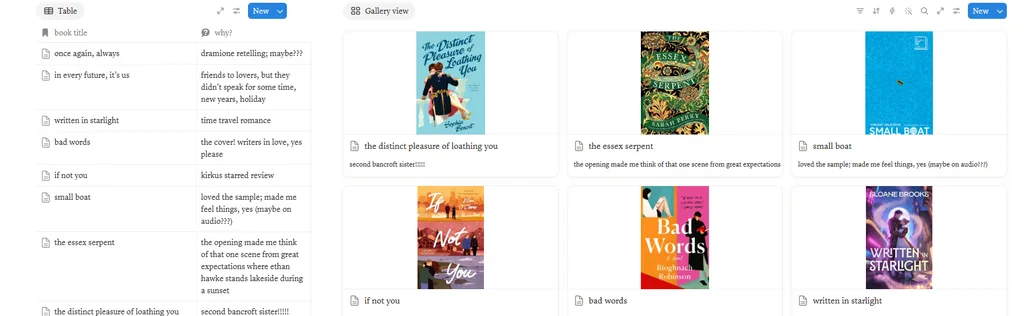
Now, we have to talk about the system you’ll use to house your wish list. Where can it live?
Personally, my very first list lived on Amazon because, well… it was the easiest way for me. All the free samples are there, it has that “add to wish list” button and it all kind of lives in one place. Plus, I can just buy books straight from there and get them on my kindle (where I read most of my books).
And you can do this too, on Amazon or any bookseller website you enjoy. Most have the free sample feature, all have something like a wish list.
It’s the simplest, easiest, no-fuss way to do this thing.
Of course, you might want to get fancy just for the joy of it, and in that case, I do have a few recommendations.
One is a notebook. I know, I know: how revolutionary of me! But in all seriousness, it’s the second (?) easiest way to maintain your wish list. Just write stuff down. How novel!
There’s also your notes app, of course, which works if you’re not a notebook or journal girlie (gender-neutral) and it makes sense if you get most of your recs from socials.
There are spreadsheets for those of you who enjoy that sort of thing, and finally Notion, which is kind of like spreadsheet but totally not.
Honestly, it can be whatever you want it to be and live wherever you want it to live. Once again, the point of it is no pressure and no homework-like feelings. Got it?
With that in mind, I have found that adding some notes to my wish list is beneficial. Here’s what I do:
- a note on why the book caught my eye in the first place; you’d be surprised how many times I had no idea why I added a book to my list, and knowing this tidbit is helpful when I come back to it to find something to read as a way to quickly sort through. The note doesn’t have to be complicated. Sometimes I just add the trope that sold me on a book, or a quote, or something someone said about it on reddit that made me want to read it.
- the release date! I often find books online that aren’t out yet, and then I get disappointed when I can’t read a book immediately when I really want to. Release dates (on not-out-yet books only) help with this.
And, that’s it! This might change in the future, but I don’t want to overcomplicate it. Plus, this is the info I find most useful.
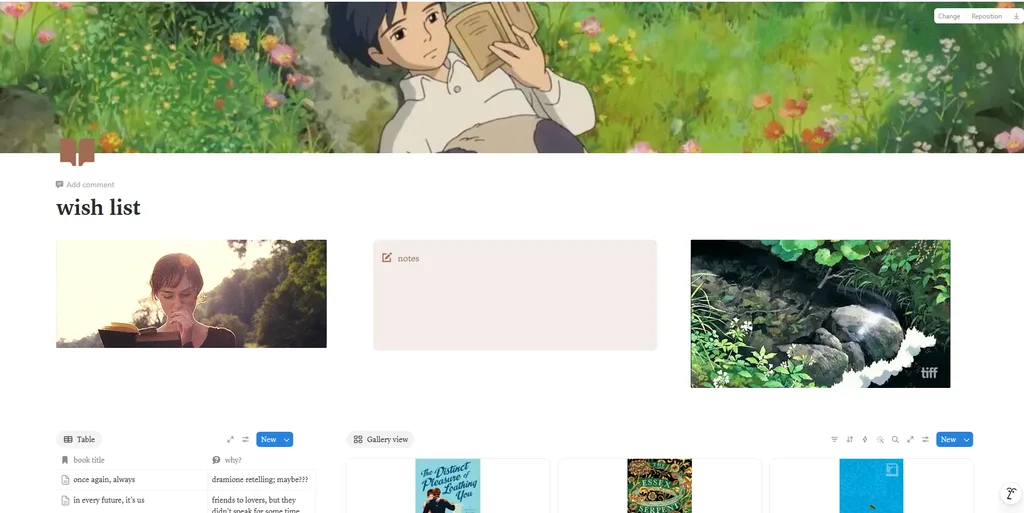
Now, since you can’t really make notes of these things on Amazon, I had to switch to something else. A notebook worked for a bit, but I like being able to see the covers, and my drawing skills are not up to snuff quite yet, so instead, I went with Notion.
If you don’t know what it is, think of it like Excel, but cute? Or maybe like a mini-website of your own, but private. I like it because I can add the book covers and all of the notes on it and it looks visually appealing and cozy to me, like my own space.
Final Thoughts
At the end of the day, managing your own reading life is, of course, entirely up to you. If you enjoy structure and knowing what comes next, TBRs are great for you. But if you’d prefer a more lax, easygoing approach, I suggest trying my wish list method. It’s easy enough to get started, and really, it’s all about making things more fun and less stressful for yourself.
What is your method for noting books you want to read? Will you try this one? Let me know in the comments and let’s chat!
